
01
Observe
Identify meaningful changes in delivery, cost and conversion patterns.
Research keywords, create image and video assets, and turn a structured brief into an editable campaign draft. Check targeting, budget, copy, creative assets and landing pages before anything reaches the account.
Route research, drafting, image, video and voice work through the same brief, review and approval process.
 OpenAILanguage and reasoning
 Google AI StudioCreative prototyping
 Google GeminiMultimodal assistance
 ClaudeResearch and drafting
 Mistral AIOpen model workflows
 PerplexityResearch workflows
 Hugging FaceModel ecosystem
 ElevenLabsVoice production
 DeepSeekReasoning workflows
The builder asks for the information that matters: objective, market, offer, audience, language, budget and landing page. Every suggestion remains easy to understand and edit.

Find relevant terms, compare monthly searches and average CPC, organize keywords by search intent and prepare negative keyword candidates before building the campaign.

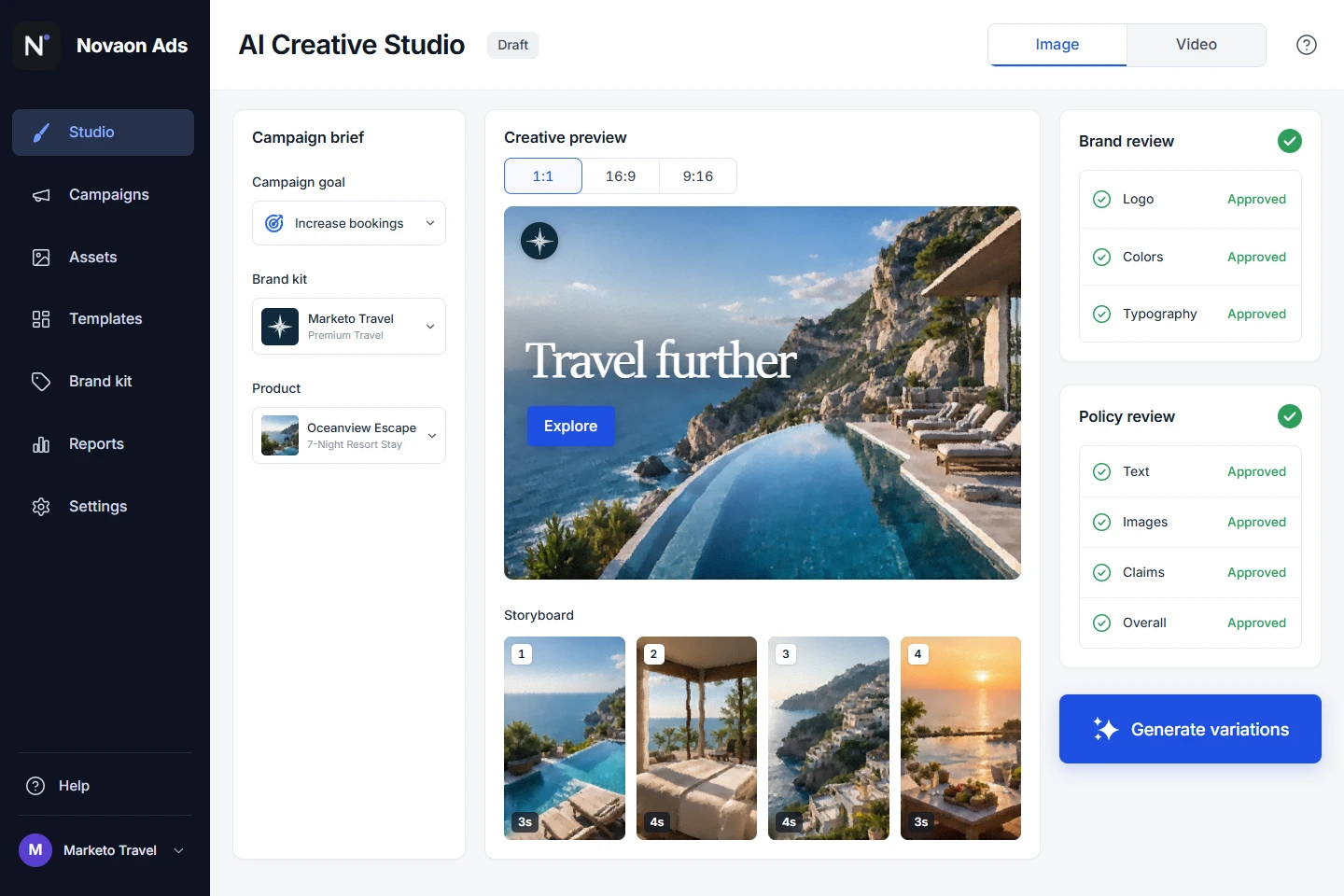
Turn the approved campaign brief into visual drafts, preview common placement ratios and keep brand and policy checks visible before any asset enters a campaign.
Describe the business, offer and goal.
Review demand, intent and keyword themes.
Prepare copy, image and video asset drafts.
Check assumptions, claims and targeting.
Adjust content, budgets and settings.
Choose whether the draft moves forward.
The optimization layer uses explainable observations, supporting data and explicit approval instead of unexplained automatic changes.
Identify meaningful changes in delivery, cost and conversion patterns.
Show the data and assumptions behind each suggested action.
Separate issues with high impact from routine noise.
Keep the operator in control of account changes.
Compare the result to the reason the change was made.
Use outcomes to improve future guidance.
Useful output begins with explicit business context. Novaon separates the source information, generated draft and human approval so teams can see where every decision came from.
| Campaign input | AI helps prepare | Your team verifies |
|---|---|---|
| Business objective and offer | Campaign direction and message themes | The commercial goal, factual claims and offer conditions |
| Market, language and audience | Keyword themes, audience ideas and localization starting points | Local relevance, exclusions and legal requirements |
| Website and landing pages | Page summaries, headline directions and URL mapping | Final URLs, mobile experience, tracking and message consistency |
| Budget and measurement | Draft structure and optimization observations | Spend limits, bid strategy, primary conversions and data quality |
| Brand kit and approved materials | Image concepts, copy variations and video storyboards | Brand accuracy, licensing, visual quality and policy compliance |
| Connected performance data | Patterns, priorities and possible next actions | Seasonality, business context, causality and final action |
Verify prices, product details, locations, availability, claims and every statement a customer could rely on.
Check tone, terminology, colors, logos, approved imagery and the relationship between the ad and landing page.
Confirm formats, character limits, targeting, keyword intent, conversion goal and the role of each asset in the campaign.
Review Google Ads policies, local requirements, sensitive categories, usage rights and any approval needed from the brand.
No. Performance depends on the offer, market, budget, measurement, creative quality, landing page, competition and many factors outside the model.
The workflow keeps a draft and review checkpoint. Operators remain responsible for checking policy, factual accuracy, targeting, budgets, measurement and final settings before publishing.
No. Review brand accuracy, visual quality, licensing, factual claims, aspect ratios and Google Ads policies before approving any generated asset.
No. Generated content is a structured starting point. Review claims, brand voice, local rules, keywords, URLs and campaign settings before use.
Keyword Research organizes demand, cost, competition and intent signals into reviewable themes. Your team decides which terms match the offer and which negatives protect traffic quality.
The advertiser or authorized account operator. AI can prepare and explain a draft, but the person responsible for the account approves what moves forward.
Use the AI Campaign Builder with a real business case.